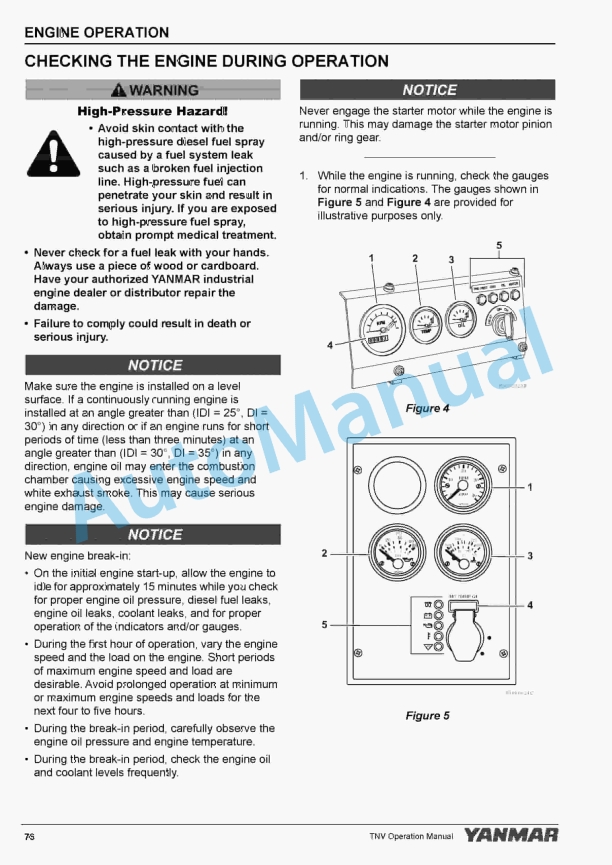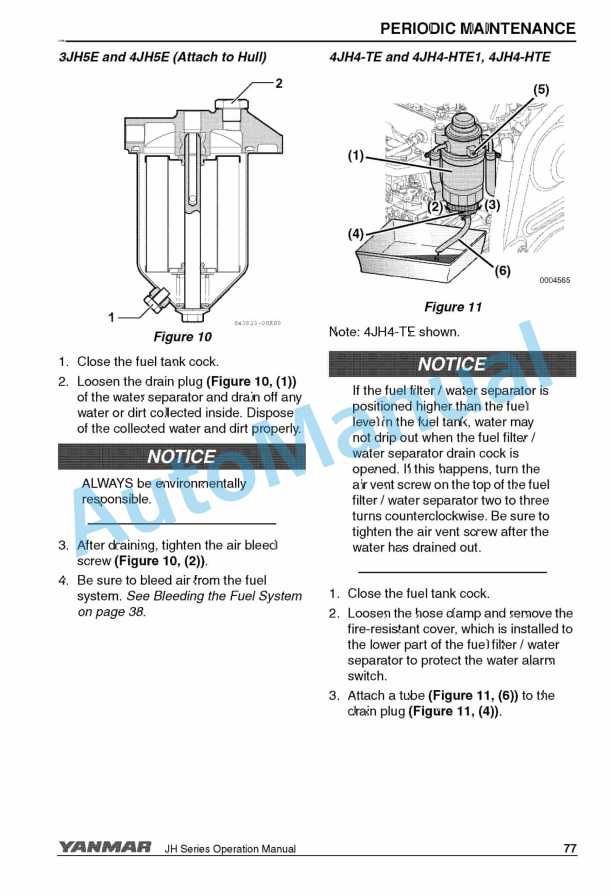
Yanmar 3TNV74F, 3TNV76F, 3TNV80F, 3TNV80FT, 3TNV88F, 3TNM74F Industrial Engine Operation Manual
$20.00
- Type Of Manual: Operation Manual
- Number of Pages: 124
- Size: 3.7MB
- Format: PDF
Category: Yanmar Operator Manual PDF
-
Model List:
- 3TNV74F, 3TNV76F, 3TNV80F, 3TNV80FT, 3TNV88F, 3TNM74F
- 1. Introduction
- 1.1. Record of Ownership
- 1.2. Symbol Explanation
- 2. Table of Contents
- 3. YANMAR Warranties
- 3.1. YANMAR Limited Warranty
- 3.1.1. What is Covered by this Warranty
- 3.1.2. How Long is the Warranty Period
- 3.1.3. What the Engine Owner must Do
- 3.1.4. To Locate an Authorized YANMAR Industrial Engine Dealer or Distributor
- 3.1.5. What YANMAR will Do
- 3.1.6. What is not Covered by this Warranty
- 3.1.7. Warranty Limitations
- 3.1.8. Warranty Modifications
- 3.1.9. Questions
- 3.2. Emission System Warranty
- 3.2.1. YANMAR POWER TECHNOLOGY CO., LTD. Emission Control System Warranty – USA Only
- 3.2.2. Your Warranty Rights and Obligations
- 3.2.3. Manufacturers Warranty Period
- 3.2.4. Warranty Coverage
- 3.2.5. Warranted Parts
- 3.2.6. Exclusions
- 3.2.7. Owners Warranty Responsibilities
- 3.2.8. What the Emergency Stationary Type Engine Owner must Do
- 3.3. Safety Statements
- 3.4. Safety Precautions
- 3.4.1. Before You Operate
- 3.4.2. During Operation and Maintenance
- 4. Product Overview
- 4.1. YANMAR TNV Engine Features and Applications
- 4.2. Component Identification
- 4.3. Location of Labels
- 4.3.1. Location of labels/nameplates on direct injection model engines
- 4.3.2. Engine Nameplate (Typical)
- 4.4. Emission Control Regulations
- 4.4.1. EPA/ARB Regulations – USA Only
- 4.4.2. EU Regulations
- 4.5. Emission Certification Labels
- 4.5.1. EPA/ARB Labels (Typical)
- 4.5.1.1. EPA and ARB
- 4.5.2. EU Labels (Typical)
- 4.5.2.1. EU Regulation 2016/1628
- 4.6. Engine Family
- 4.7. Function of Major Engine Components
- 4.8. Function of Cooling System Components
- 4.9. Electronic Control System
- 4.10. Main Electronic Control Components and Features
- 4.11. Gauges and Indicators
- 4.11.1. Tachometer
- 4.11.2. Engine coolant temperature
- 4.11.3. Engine oil pressure
- 4.11.4. Hourmeter
- 4.11.5. HEAT indicator (Standard glow (preheat) control)
- 4.11.6. HEAT indicator (ON-glow control)
- 4.11.7. Battery charge
- 4.11.8. Engine oil pressure
- 4.11.9. Engine coolant temperature
- 4.11.10. Auxiliary
- 4.12. Gauges and Indicators of Electronic Control System
- 4.12.1. Indicators
- 4.12.1.1. Engine failure lamp (optional)
- 4.12.1.2. Auxiliary
- 4.12.1.3. Others (optional)
- 4.13. Controls
- 4.13.1. Key Switch
- 4.13.1.1. OFF (key straight up and down)
- 4.13.1.2. OFF (key straight up and down)
- 4.13.2. Glow Plugs
- 4.13.3. Governor Lever
- 4.13.4. Engine Stop Solenoid
- 4.13.5. Electronic Engine Speed Control
- 4.13.5.1. Speed control of electronic controlled engines
- 4.13.5.2. Start and stop of electronic controlled engines
- 4.13.5.3. Engine performance curves
- 5. Before You Operate
- 5.1. Diesel Fuel
- 5.1.1. Diesel Fuel Specifications
- 5.1.1.1. Additional technical fuel requirements
- 5.1.1.2. Precautions and concerns regarding the use of diesel fuel
- 5.1.1.3. Biodiesel fuels
- 5.1.2. Filling the Fuel Tank
- 5.1.3. Priming the Fuel System
- 5.2. Engine Oil
- 5.2.1. Engine Oil Specifications
- 5.2.1.1. Service categories
- 5.2.1.2. Definitions
- 5.2.1.3. Additional technical engine oil requirements
- 5.2.2. Engine Oil Viscosity
- 5.2.3. Checking Engine Oil
- 5.2.4. Adding Engine Oil
- 5.2.5. Engine Oil Capacity (Typical)
- 5.3. Engine Coolant
- 5.3.1. Engine Coolant Specifications
- 5.3.1.1. Alternative engine coolant
- 5.3.2. Filling Radiator with Engine Coolant
- 5.3.3. Daily Check of the Cooling System
- 5.3.4. Engine Coolant Capacity (Typical)
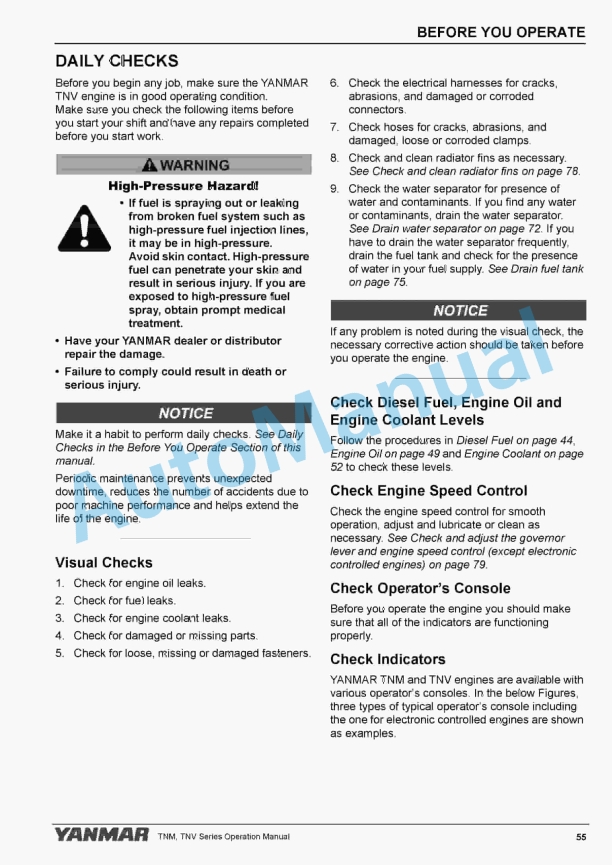
- 5.4. Daily Checks
- 5.4.1. Visual Checks
- 5.4.2. Check Diesel Fuel, Engine Oil and Engine Coolant Levels
- 5.4.3. Check Engine Speed Control
- 5.4.4. Check Operators Console
- 5.4.5. Check Indicators
- 5.4.5.1. Battery charge
- 5.4.5.2. Engine oil pressure
- 5.4.5.3. Engine coolant temperature
- 5.4.5.4. Auxiliary
- 5.4.5.5. Engine failure lamp (optional)
- 6. Engine Operation
- 6.1. Starting Engine
- 6.1.1. Cold start device for electronic controlled engines
- 6.1.2. High-Altitude Injection Control Device
- 6.2. Checking the Engine During Operation
- 6.2.1. Adjust Engine Speed
- 6.3. Shutting Down the Engine
- 7. Periodic Maintenance
- 7.1. Precautions
- 7.1.1. The Importance of Periodic Maintenance
- 7.1.2. Performing Periodic Maintenance
- 7.1.3. The Importance of Daily Checks
- 7.1.4. Keep a Log of Engine Hours and Daily Checks
- 7.1.5. YANMAR Replacement Parts
- 7.1.6. Tools Required
- 7.1.7. Ask Your Authorized YANMAR Industrial Engine Dealer or Distributor For Help
- 7.1.8. Required EPA/ARB Maintenance USA Only
- 7.1.9. EPA/ARB Installation Requirements USA Only
- 7.1.10. Tightening Fasteners
- 7.2. Standard Torque Chart
- 7.3. Periodic Maintenance Schedule
- 7.3.1. Periodic Maintenance Chart
- 7.4. Periodic Maintenance Procedures
- 7.4.1. After Initial 50 Hours of Operation
- 7.4.1.1. Check and adjust cooling fan V-belt
- 7.4.2. Every 50 Hours of Operation
- 7.4.2.1. Drain water separator
- 7.4.2.2. Check battery and recharge
- 7.4.3. Every 250 Hours of Operation
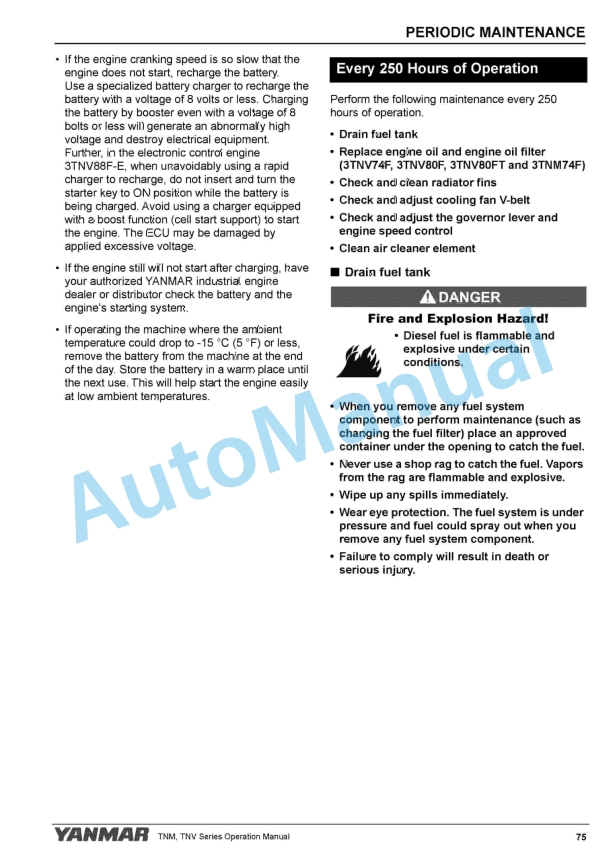
- 7.4.3.1. Drain fuel tank
- 7.4.3.2. Replace engine oil and engine oil filter (3TNV74F, 3TNV76F, 3TNV80F, 3TNV80FT and 3TNM74F)
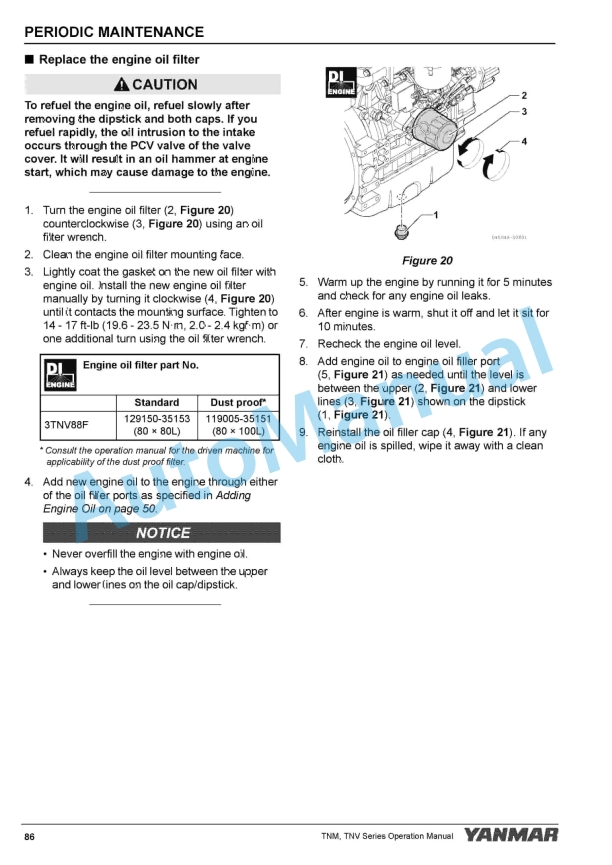
- 7.4.3.3. Replace the engine oil filter
- 7.4.3.4. Check and clean radiator fins
- 7.4.3.5. Check and adjust cooling fan V-belt
- 7.4.3.6. Check and adjust the governor lever and engine speed control (except electronic controlled engines)
- 7.4.3.7. Clean air cleaner element
- 7.4.4. Every 500 Hours of Operation
- 7.4.4.1. Replace air cleaner element
- 7.4.4.2. Replace fuel filter (element)
- 7.4.4.3. Clean water separator
- 7.4.4.4. Replace engine oil and engine oil filter (3TNV88F)
- 7.4.4.5. Replace the engine oil filter
- 7.4.5. Every 1000 Hours of Operation
- 7.4.5.1. Check and adjust intake/exhaust valve clearance
- 7.4.6. Every 1500 Hours of Operation
- 7.4.6.1. Inspect, clean and test fuel injection nozzle
- 7.4.6.2. Inspect crankcase breather system
- 7.4.7. Every 2000 Hours of Operation
- 7.4.7.1. Check and replace fuel hoses and engine coolant hoses
- 7.4.7.2. Change coolant
- 7.4.8. Every 3000 Hours of Operation
- 7.4.8.1. Inspect ECU and related sensors and actuators
- 7.4.8.2. Inspect turbocharger (blower wash as necessary)
- 7.4.8.3. Inspect, clean and test EGR valve
- 8. Troubleshooting
- 8.1. Troubleshooting Chart
- 8.2. Troubleshooting of Electronic Control System
- 8.2.1. Fault Detection Capability
- 8.2.2. SMARTASSIST-DIRECT
- 8.3. Troubleshooting Information
- 8.4. List of Possible Faults of Electronic Controlled Engines
- 9. Long-Term Storage
- 9.1. Before You Place the Engine In Long-Term Storage
- 9.2. Returning the Engine to Service
- 10. Specifications
- 10.1. Engine General Specifications
- 10.2. Principal Engine Specifications
- 10.2.1. NM74F
Rate this product
You may also like
Yanmar Operator Manual PDF
Yanmar 4JH3-TE, 4JH3-TCE, 4JH3-HTE, 4JH3-DTE Marine Diesel Engine Operation Manual
$20.00
Yanmar Operator Manual PDF
Yanmar 4CHL-N, 4CHL-TN, 6CHL-N, 6CHL-TN, 6CHL-HTN Marine Auxiliary Engine Operation Manual
$20.00
Yanmar Operator Manual PDF
$20.00
Yanmar Operator Manual PDF
Yanmar 1GM10, 2GM20(F), 3GM30(F), 3HM35(F) Engine Operation Manual
$20.00
Yanmar Operator Manual PDF
Yanmar 2TNV70 to 4TNV106T Industrial Engines Operation Manual 0ATNV-EN0019
$20.00
Yanmar Operator Manual PDF
$20.00
Yanmar Operator Manual PDF
Yanmar 4LHA-HTP, 4LHA-DTP, 4LHA-STP, 4LHA-HTZP, 4LHA-DTZP, 4LHA-STZP Marine Engine Operation Manual
$20.00
Yanmar Operator Manual PDF
$20.00